Friday, 26 October 2018

What Is a Recruitment Flowchart, and How Do I Make One Today?

When you have a job order to fill, it’s important to stay organized. There are many steps between receiving a job order and making a placement. You don’t want to lose track of where you’re at in the employee recruitment process. Try using a recruitment flowchart to stay on top of things.

What is a recruitment flowchart?

A flowchart of recruitment and selection process, also called a recruitment workflow, is a diagram that maps out the sequence of recruiting. The flowchart uses symbols and arrows to show you what to do in each step in the recruitment process, starting with receiving a job order and ending with onboarding the candidate.
In recruiting, countless what-ifs could throw the whole process into chaos. What if a qualified candidate isn’t found? What if the candidate rejects the job offer? A recruitment flowchart can help you combat issues like these.
Like any process, recruiting is done in the same basic order each time. By creating a visual to track it, you are creating a roadmap. Follow the recruitment flowchart process to see where you go next.
Use the recruitment process steps to create your recruitment workflow diagram.

Recruitment process steps

It’s important to understand the process of full cycle recruiting to effectively design your recruitment and selection flowchart.
Depending on your recruiting strategy, there might be more or less steps to the recruitment process. Take a look at the basic steps in the recruitment process:
  1. Receive job order from client
  2. Source potential candidates (i.e., job board sites, social media, recruiting software database)
  3. Resume screening
  4. Screen candidates and pass along to client
  5. Coordinate interview process
  6. Conduct background and reference checks
  7. Select candidate and extend job offer
  8. Place the candidate
  9. Engage in onboarding process
You can use these recruitment process steps to create a recruitment flowchart.

Recruitment flowchart template

Flowcharts can be vertical or horizontal, whichever works best for you. They can start at the top and go to the bottom, or start at the left and move to the right.
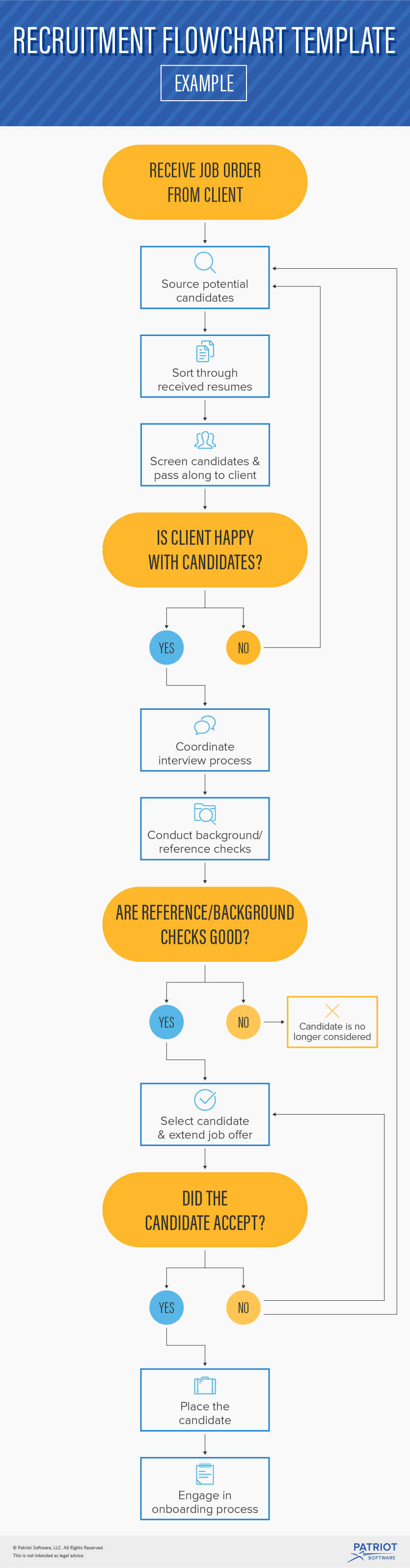
The symbols in a flowchart represent stages in the process. When each step has been achieved, you can move on to the next symbol in the flowchart, aka the next step in the process.
There are many symbols a flowchart uses. Take a look at some of the basic symbols used in a recruitment flowchart:
  • Oval: Start/end process
  • Arrows: Lead from one step to the next
  • Rectangles: Steps in the process
Take a look at this recruitment flowchart template example:
Recruitment Flowchart

How to create your own recruitment procedure flowchart

Some people prefer to make a flowchart using a pen and paper. Others like to use computer programs to make neat and organized diagrams. Use whatever works for you.
If you want to, you can change the symbols up. Because this is your personal recruitment flowchart, it’s important that you understand the meaning of each visual.
Once you create your initial template, you can use it every time you have a job order. Mark off the steps as you complete them.

Benefits of a recruitment flowchart

Using a recruitment flowchart has many positives. Sixty-five percent of people are visual learners, meaning it’s much easier for them to absorb information from images, pictures, or related visuals to understand content.
If you fall into this 65%, a recruitment flowchart might become your best friend. Using a recruitment flowchart can keep you organized. Some recruiters might get overwhelmed with the recruiting process, which can lead to skipping steps or losing data.
CREDIT: TPCLN

Poll Results: Recruiting Qualified, Passive Candidates “Difficult”

Sure, there are millions of job seekers in the marketplace right now. Obviously, those people don’t have to be recruited for an open position as much as, say, a passive candidate who really isn’t looking for a new opportunity.
However, as any recruiter will tell you, many companies are looking for those hard-to-find, passive candidates with the superstar skill set and potential to contribute considerably to the organization’s bottom line.
Finding those candidates is just the first step in the process. Successfully recruiting passive candidates is where the real work is done. Recruiters must sell the candidate on the opportunity if they want to more fully satisfy their client’s needs.
But exactly how easy—or difficult—is it to recruit those types of candidates? Well, we conducted a poll of Top Echelon Network recruiters to find out the answer to that question:
    Overall, how easy or difficult is it right now to recruit qualified, passive candidates?

Results:

We presented a choice of six answers, which are listed below, along with the percentage of recruiters that chose each one:
  • Very easy—1.1%
  • Somewhat easy—7.4%
  • Neither easy nor difficult—21.1%
  • Somewhat difficult—48.4%
  • Very difficult—22.1%

Analysis:

As you can see, nearly half of recruiters (48.4%) indicated that recruiting passive candidates is “somewhat difficult,” and another 21.1% stated that it’s “very difficult.”
Put those answers together, and 69.5% of recruiters believe that recruiting such candidates is difficult to some degree. On the flip side of the coin, 7.4% indicated that recruiting passive candidates is “somewhat easy.” As for “very easy”? Hardly anybody believes that’s the case right now at 1.1%.
So it’s not even close: recruiting qualified, passive candidates is difficult!

Conclusion:

This is basically a good news-bad news situation.
The good news: companies are hiring. In fact, not only are companies hiring, but they are more than willing to use recruiters in order to find the candidates they need.
The bad news: qualified, passive candidates are not only difficult to find (which is one of the reasons that companies are willing to use recruiters), but they’re also difficult to recruit!
This means there are plenty of job orders that recruiters can work. So . . . what situation would recruiters rather face?
  • A lack of job orders
  • A lack of qualified candidates
Sure, it might be difficult to fill the order. But you HAVE the order. The candidate is out there . . . somewhere. You just have to find them.
And recruit them.
CREDIT: TPCLN

The 10 Most Critical Recruitment Process Steps

What is the recruitment process?

A recruitment process is an organization-specific model of candidate sourcing for the purpose of finding and hiring new employees. Typically, the ownership of the recruitment process resides within the Human Resources function, although companies also use third-party recruiting firms. Ownership can vary depending upon the specific organizational structure of the company carrying out the process.

Are the hiring process steps always the same?

Of course, every organization and company is different. What works well for one company may not work well for another. That’s why the ability to be self-aware is a crucial component of the recruiting process. You can’t do what sounds like it might work within your organization. You must do what does work.
One thing that organizations (your clients) must remember is that the recruitment procedure involves actual recruiting. That’s because these organizations should be going after top-shelf, A-level candidates. These type of candidates need to be recruited. Why? Because they’re not actually looking for a job! They’re probably already being paid well and treated well by their current employer. However, recruiting passive candidates is NOT easy.
That’s why a company’s recruitment procedure should not just consist of submitting a position to online job posting boards, sitting back, and waiting for the applications to roll in. That’s not going to result in the sourcing and hiring of the best candidates possible. It might result in the sourcing and hiring of the best candidates actively looking for a new job. It’s not the same thing.
When company officials examine their organization’s hiring process steps, they must have a proactive mindset. In other words, their focus should be on identifying, recruiting, interviewing, hiring, and retaining the best candidates available in the marketplace. (Regardless of whether they’re actively seeking new employment). That—in a nutshell—is what the recruitment process is all about.

Recruitment process steps

But . . . there’s a little more to it than that, as you might imagine. Okay, so company officials must be self-aware and know what works for their organization and what doesn’t. They must also act proactively and have the proper frame of mind at the outset. Creating a basic recruitment flowchartcan sometimes be helpful to keep you on track.
With all of this in mind, below are the 10 basic steps in the recruitment process. (Remember, the process in individual to each organization, meaning they might omit steps, add steps, move them around, or all three.)

#1—Identifying the hiring need

You can’t find what you need . . . if you don’t know what you need. It’s not enough to know that you need [insert position title here]. You must also know the complete job description. However, you must know the description as the last employee who left in the position left it, NOT the description when that person took the job. That’s because chances are good that they took on new/additional responsibilities while in the position. Now the job when they left is different than they job when they arrived.

#2—Planning

Once you’ve identified exactly what you need (both in terms of hard skills and soft skills), then it’s time to put a plan together to find what you need. You know what they say: “When you fail to plan, you plan to fail.” Yadda-yadda-yadda . . . except it’s absolutely correct. Make sure that you get the “buy in” of everybody involved with the hiring process on the steps that will be taken and the communication channels that will be used. All it takes is one misstep to blow everything up.

#3—Searching

This is a case where you need to be a “hunter” and not a “gatherer.” Too many companies are “gatherers,” thinking that superstar candidates are going to rain down from the sky like so much manna. No, they are not. Once again, this is why companies hire “headhunters.” They hunt, they do not gather. Not only that, but they’re good at what they do. Hiring authorities and even companies with internal recruiters often cannot match the expertise and connections of a recruiter who “works in the trenches” of the industry day after day.

#4—Identifying viable candidates

Finding candidate is also not enough. An organization (or its recruiter) must also find qualified candidates. Anybody can find candidates. They’re everywhere. But those high-level A-players, the kind of candidates your competition would kill for? They’re NOT everywhere. So searching for them, finding them, and identifying them will be more difficult if the first three steps in the process have not been undertaken.

#5—Recruiting of A-level candidates

Once viable candidates have been identified, they must be recruited. In other words, they must be sold on not only the opportunity, but also on the organization. Some organizations miss this important distinction. Top candidates are not just interested in a great new job. They’re interested in a great new job with a great new employer. If they like the job, but they don’t also like the employer, then they’re not going to take the job. As mentioned above, recruiting is a major facet of the recruitment process.

#6—(Telephone) screening

Sure, you have a batch of viable candidates, most likely passive candidates, who are interested in the position. But not every single one of them are going to make it through the process. That brings us to the first screening stage of the process, the telephone interview. Ideally, you would have a list of 10 to 15 very strong candidates, all of whom are interested in the position. The phone screening serves to whittle that list down, so that you can move to the next stage of the process, which is . . .

#7—(Face-to-face) interviewing

There are two important aspects of this part of the recruitment process:
  1. It can’t stretch out too long, or candidates involved will lose interest.
  2. Employers must communicate to candidates where they are in the process and what to expect in the near term or they will start looking elsewhere. This is a particular danger with top candidates, since they are more than likely interviewing with more than one organization.
Sure, there are other important aspects of the interview stage, but these are the two that companies neglect the most, with predictably dire consequences.

#8—Offering of employment

The offer stage is one of the most delicate stages of the recruiting process. A hiring manager should never take for granted that a candidate is going to accept an offer. However, if they’ve done all of the proper work beforehand and they’ve double and triple-checked everything, then the candidate should accept the majority of the time. Here’s an important note: if an organization is working with a search consultant, the hiring manager of that organization should let the search consultant extend the offer. That’s what the candidate expects, and that’s what should happen.

#9—Hiring of the candidate

Why are the offer step and the hire step not combined into one step? Because not every offer of employment is accepted. If every offer was accepted, then yes, we could do that. If a #1 candidate rejects the offer, then the company might extend the offer to their #2 candidate . . . or their #3 candidate, if #2 falls through. Once a candidate does accept the offer of employment, though, that’s when the official hire can be made.

#10—Onboarding of the candidate

What’s the point of hiring the best candidates in the marketplace if you can’t retain those candidates after you’ve hired them? A comprehensive onboarding process is perhaps the most crucial steps in the recruiting process. When we refer to onboarding, we’re talking about more than just new employee paperwork and knowing where the bathrooms are located. We’re talking about continuing to make the candidate/new employee feel wanted before they officially join the organization. Many a company has failed to do that, only to see their new employee never show up for their first day of work.
One of the best ways to make more placements is to speed up the recruitment process. Sure, there’s not much you can do about how fast your clients move. But your recruiting software? You’d better be using a recruiting applicant tracking system that’s simple, powerful, and designed to save time and energy during the process.
Because the faster you get the best candidates in front of your clients, the better.
CREDIT: TPCLN

100 Behavioral Interview Questions to Help You Find the Best Candidates

As a recruiter, it’s your job to find the best candidates to send your clients. But how do you know if a candidate will be a good fit?
You should get to know each of your candidates a little bit. Read their resume. Interview them. Ask questions about the specific things your client is looking for.
When you’re talking to a candidate, you will likely ask them behavioral interview questions. These questions can help you determine if a candidate’s personality and character match what your client wants.

What are behavioral interview questions?

You can use behavioral interview questions to ask candidates how they acted in specific situations. Typically, you will ask the candidate to describe a situation and how they acted in it. The candidate should then respond with an example.
Behavioral based interview questions let you avoid hypothetical questions during the recruitment and hiring process. Instead of saying, “What would you do if …” you can ask, “How did you react when …” You gather concrete information about how the candidate actually behaves.
There are no correct answers to behavioral interview questions. Everyone’s answer will depend on their past experiences. The goal is to find out how the candidate personally reacted in real-life situations.

Why should you ask behavioral interview questions?

When you ask behavioral interview questions, you can focus on key behaviors that your client wants. For example, if your client is looking for someone who can handle sudden project changes, ask behavioral questions about how the candidate reacts to change. You can record your candidate’s responses in your recruiting software, so you can easily compare your notes to your client’s expectations.
Asking the best behavioral based interview questions can help you weed out candidates that don’t fit your client’s description, so you send only the best candidates to your client.
You can also use typical behavioral interview questions to prepare a candidate for an interview with your client. You can do practice questions with your candidate, or give them a list of questions to prepare.

List of behavioral interview questions

There are a lot of possible behavioral interview questions you can ask your candidate. The ones you ask should be related to the job opening.
Below are common behavioral interview questions. They are divided by topic so you can easily choose the best ones to use.

Attention to detail interview questions

1. What do you do to verify that your work is accurate?
2. Describe a time you made an error. Why did you miss the mistake? How did you handle the situation?
3. Can you describe a time when a co-worker made a mistake and you discovered it? What did you do?

Analytical skills interview questions

4. Can you describe a project that demonstrated your analytical skills?
5. Can you tell me about a time when you had to analyze information? Why were you analyzing the information? What was your process?
6. Can you talk about a time when you used your analytical skills to find a problem? How did you discover the problem? What did you do after you discovered it?
7. Can you tell me about a time when you used your problem solving skills to find a solution to a problem?

Interview questions about decision making

8. What steps do you take before making a decision?
9. Can you talk about a time you had to make a decision with limited information? How did you determine what would be the best decision?
10. Can you tell me about a time when you had to make an immediate decision?
11. Can you tell me about a time when you felt pressure while making a decision? How did the pressure affect you?
12. What’s the most difficult decision you’ve made at work? How did you come up with your decision?
13. Can you talk about a decision you made that impacted your co-workers? How did you choose the right decision?
14. Was there a decision you made that wasn’t popular? What did you do?
15. Can you describe a decision that you regretted? Why did you regret it?

Leadership interview questions

16. Can you describe a time when you were in charge of a project? What would you do differently?
17. Can you talk about a time when a project didn’t have a leader, but you took charge? Why did you take charge? What did you do?
18. Can you tell me about a time when you had a difficult group to lead? What did you do to manage them?
19. What was the toughest project you had to lead? Why was it difficult?
20. What is the most difficult part of being a leader for you? What do you do about that?
21. Can you describe something that challenged you as a leader? How did the challenge change you?
22. What was your greatest achievement as a leader? What were you most proud of?
23. Can you talk about a time when you motivated your team? How did you do it? How effective were your efforts?

Interview questions about taking initiative

24. Can you describe a time when you saw a problem at work and created a solution for it.
25. Can you tell me about a time you made a change at work?
26. Can you talk about a project that you started? What did you do? What were the results?
27. Can you tell me about a project that was implemented because of the work you did?
28. Can you tell me about a time when you were bored at work and sought for more or different work? What steps did you take?

Interview questions about goal setting

29. Can you describe the process you use to set personal goals?
30. Can you talk about a career goal you made? Did you reach it? What obstacles did you encounter?
31. Can you tell me about a goal that you set but didn’t reach? Why didn’t you reach it? How did you feel?
32. What goals did you set for your team? How did you keep people on track to meet the goals?

Interview questions about sales

33. What have you done to increase your number of customers?
34. What is your greatest accomplishment in sales? How did you achieve that?
35. Can you tell me about a time when you convinced a reluctant customer to make a purchase? How did you do it?
36. Can you talk about a time when you had to negotiate with a customer? What did you do? What was the outcome?

Customer service interview questions

37. Can you describe the steps you take to develop a relationship with a customer?
38. Can you tell me about a time that you were unsure about a customer’s request? What did you do?
39. Can you talk about a time when you and a customer miscommunicated? What did you do to repair communication?
40. Can you talk about a time when you dealt with an upset or angry customer? What did you do? Is there anything you would have done differently?
41. Can you tell me about a time you convinced a customer to stay with the business? What steps did you take?
42. Can you describe a time when you went out of your way to please a customer?
43. Have you ever defended a customer? Why? How did your co-workers or boss react?
44. Was there ever a time when a co-worker’s customer was passed off to you? How did you let the customer know? How did you build relationship and trust with them?

Communication interview questions

45. Can you tell me about how you communicated with your previous bosses?
46. Can you tell me about a time when you communicated with a person you didn’t like?
47. Can you talk about a time when your communication failed? What caused the problem? How did you handle the situation?
48. Can you describe a time when you had to work with a remote co-worker? How did you stay in touch? What difficulties did you experience?
49. Have you ever given a speech or presentation for your job? How did you prepare? How was the presentation received?
50. Can you describe a time when you had to give a presentation without preparation? What did you do?
51. Can you talk about how you’ve used your written communication skills?
52. Can you tell me about a time when you used a communication method that was outside the norm for what you were doing? What did you do? Was it effective?

Interview questions about interpersonal skills

53. Can you describe a time when you had a conflict with someone at work? What did you do?
54. Can you describe a time when you dealt with a co-worker you didn’t like?
55. Can you tell me how you communicate with someone who doesn’t like you?
56. Can you tell me about a time when you disagreed with a manager? What did you do?
57. How have you maintained relationships with your co-workers? What skill do you use?
58. Was there ever a time that you didn’t get along with a customer? What did you do?

Interview questions about teamwork

59. What role do you normally take on a team? Why?
60. Can you tell me about your most recent experience working with a team? What was your role? How did you interact with the other team members?
61. Can you talk about a time when team members disagreed with you? What did you do?
62. Can you describe a time when you tried to solve a dispute within the team? What was the result?
63. Was there ever a time when you were part of a team where the people didn’t get along? What happened? What did you do?
64. Can you talk about a time when your team members had to compromise? What was the result?
65. Can you describe a time when a team member wasn’t doing their work? What did you do?
66. Can you describe a time when you had to delegate work among a team? How did you decide who would do each task? Is there anything you would do differently?
67. Can you tell me about a time when you let your team down? What did you do? How did you react?

Time management interview questions

68. When you schedule out the work you need to do, how do you decide what to do first?
69. Can you tell me about a project you were in charge of? How did you organize the tasks and make sure everything got done?
70. Can you describe a time when you were part of multiple projects at the same time? How did you handle the workload?
71. When you have multiple requests from customers or co-workers, how do you prioritize them?
72. Can you tell me about a time when you were behind on a project? What did you do?

Interview questions about handling stress

73. Can you describe a stressful work situation you experienced? How did you handle the situation?
74. What was your most stressful project? Why was it stressful? What did you do to manage the stress? How did the project turn out?
75. Can you tell me about a time when you saw a situation that could have become stressful? What did you do to prevent it?
76. Can you tell me about a time when you tried to reduce stress for a co-worker?

Interview questions about adaptability

77. Can you tell me how you handled your transition between different jobs or positions in the past?
78. Can you describe a time when changes happened that you couldn’t control? How did you react?
79. Can you describe a time when you experienced rapid change? How did you handle the situation?
80. Can you tell me about a time when you changed the course of a project? How did you relay the changes to your team? Is there anything you wish you would have done differently?
81. Can you talk about a time when you had to adapt to a co-worker’s work style to finish a task? What did you do?
82. Can you think of a time when you weren’t comfortable with a change? What did you do?

Interview questions about innovation

83. Can you describe a time when a manager asked you to come up with a creative way to complete a project? What steps did you take?
84. Can you tell me about a problem you solved in a unique way? What happened?
85. Can you describe a project where none of the usual paths to completion worked? What did you do instead?
86. Can you talk about a time when you presented a creative idea to your co-workers.
87. Can you tell me about a time when your creative idea received resistance from co-workers? How did you react? How did you feel?
88. Can you tell me about a time when your creative idea failed? How did you feel? What would you do differently?

Interview questions about integrity

89. Can you describe a time when a co-worker or customer questioned your honesty? What did you do?
90. Can you tell me about a time when you followed a rule that you didn’t agree with? Why did you comply? How did you feel?
91. Can you talk about a time when it was difficult to be honest?
92. Was there ever a time when you weren’t honest at work? What happened?
93. Has there ever been a situation where you thought it was better to be dishonest? Why? What did you end up doing?
94. Can you tell me about a time when you found out that a co-worker was doing something wrong? What did you do?

Resilience interview questions

95. Can you talk about a setback you had at work? What did you do?
96. Describe a time you faced a problem at work? What did you do? What would you do differently?
97. Can you tell me about a time you had to work under a lot of pressure? How did you handle the situation?
98. Can you describe a time that you faced a challenge at work? How did you feel? What steps did you take?
99. Was there ever a time you had to compete against co-workers? What were the results?
100. Can you tell me about a time when you made a mistake? What did you do? What did you learn from the situation? Was there anything you’d do differently?

Credit: TPCLN